

当前位置:新闻动态
U.S. Navy Sea Drones Make Combat Debut in Operations Near Hormuz
来源: 编辑:编辑部 发布:2026/07/15 09:47:09
The U.S. military has employed autonomous maritime systems in combat for the first time, with U.S. Central Command confirming that unmanned surface vessels participated in strikes against Iranian naval infrastructure as Washington continues operations aimed at protecting commercial shipping through the Strait of Hormuz.
According to CENTCOM, U.S. forces carried out a wave of strikes against Iranian targets on July 12, using fighter aircraft, naval vessels, one-way attack aerial drones, and one-way attack sea drones to hit air-defense systems, coastal radar sites, missile and drone capabilities, and small boats.
In a separate update posted Monday, CENTCOM said three Corsair unmanned surface vessels struck a submarine and ship maintenance facility at Bandar Abbas Naval Base, describing it as the first time American forces have employed sea drones in combat operations.
Yesterday, using multiple one-way attack surface drones, CENTCOM forces successfully struck a submarine and ship maintenance facility in Iran. Three Corsair unmanned surface vessels hit the port at Bandar Abbas Naval Base, marking the first time American forces have employed sea… pic.twitter.com/bOM2kmgRxz
— U.S. Central Command (@CENTCOM) July 13, 2026
The combat debut comes just weeks after another milestone for autonomous maritime systems in the same region.
In June, a U.S. Navy-operated Saronic Corsair autonomous surface vessel rescued two U.S. Army aviators after their AH-64 Apache helicopter crashed off the coast of Oman, marking what is believed to be the first publicly reported personnel recovery conducted by an unmanned surface vessel.
According to U.S. Central Command, the helicopter went down while conducting patrol operations near Oman. Reuters later reported, citing CENTCOM spokesperson Navy Capt. Tim Hawkins, that a Saronic Corsair autonomous surface vessel recovered the two pilots from the water before transferring them to a helicopter for evacuation.
“The drone picked them up and transported them to another location on the water where they were hoisted up to a helicopter for further transport,” Hawkins told Reuters.
The rescue was carried out by U.S. Naval Forces Central Command and U.S. 5th Fleet’s Task Force 59, the Navy unit responsible for integrating unmanned systems and artificial intelligence into maritime operations.
Together, the two operations represent a rapid evolution in how the U.S. military is employing autonomous maritime systems.
For years, unmanned surface vessels have primarily been used for surveillance, reconnaissance and experimentation. Within little more than a month, however, the same Corsair platform has now been used both to rescue downed aviators and to conduct offensive combat operations against Iranian military infrastructure.
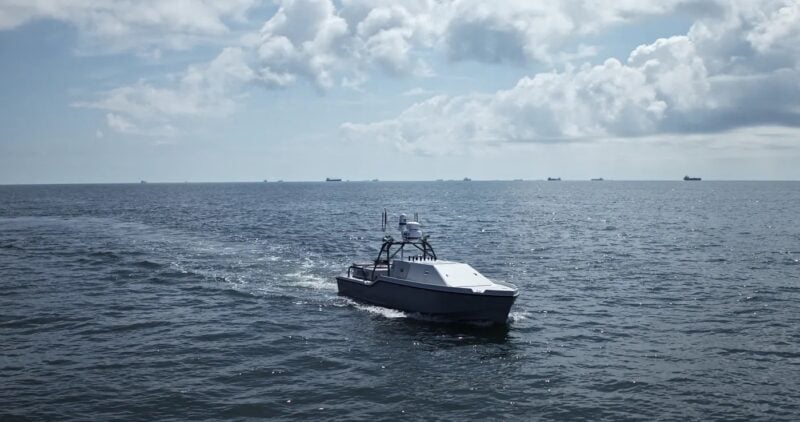
The Corsair is a 24-foot autonomous surface vessel developed by Texas-based Saronic for maritime security, surveillance, force protection and logistics missions. The diesel-powered platform can operate autonomously or under remote supervision, carrying payloads of up to 1,000 pounds over distances exceeding 1,000 nautical miles.
Saronic has emerged as one of the fastest-growing companies in the U.S. maritime autonomy sector. In April, the company raised $1.75 billion in Series D funding at a $9.25 billion valuation and has since expanded its autonomous vessel portfolio with larger platforms, including the 52-foot Mirage and the 180-foot Marauder, as it ramps up domestic production.
The latest combat employment also reflects the growing operational role of Task Force 59, which has spent the past several years integrating autonomous surface vessels into maritime security operations across the Persian Gulf, Gulf of Oman, Red Sea, Gulf of Aden and Arabian Sea. Task Force 59, established in September 2021 under the U.S. Fifth Fleet in Bahrain, is the U.S. Navy’s first Unmanned and Artificial Intelligence Task Force.
The use of autonomous drones also reflects lessons drawn from the war in Ukraine, where explosive-laden unmanned surface vessels have repeatedly damaged or destroyed Russian warships and forced much of the Black Sea Fleet to relocate from Crimea.
With the Strait of Hormuz remaining at the center of the ongoing U.S.-Iran conflict, autonomous vessels are now moving beyond experimentation into front-line missions, carrying out both life-saving search-and-rescue operations and precision strikes while reducing risk to U.S. personnel.